
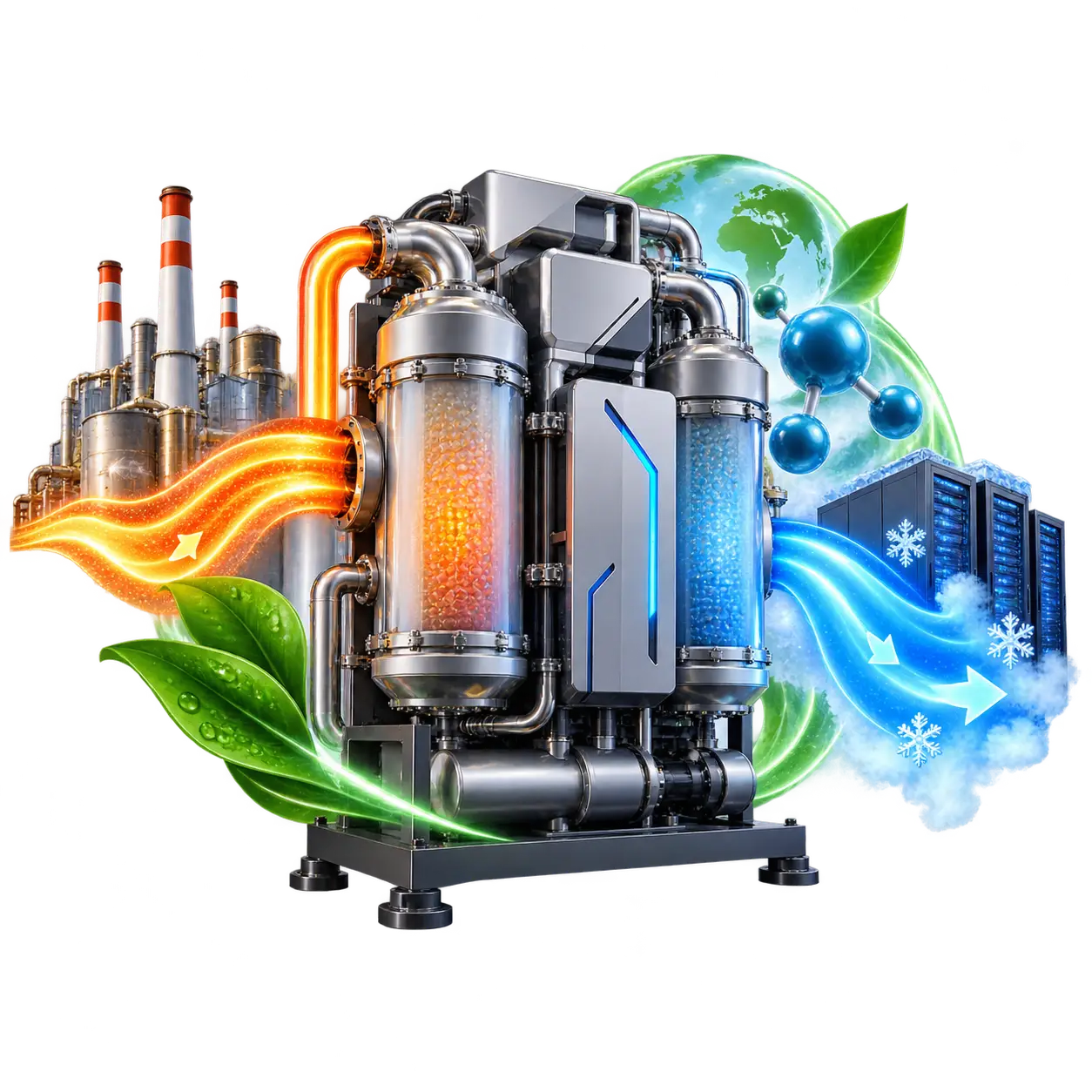
South Korea, September 6, 2026: Researchers in South Korea have developed a chemical adsorption heat pump capable of generating cooling from low-temperature waste heat of around 40°C, opening a potential new route for recovering otherwise discarded heat from factories and data centres.
The system was developed by a team led by Dr Young Kim, principal researcher at the Heat Pump Research Centre of the Korea Institute of Machinery and Materials (KIMM), in collaboration with Professors Minseong Kim and Dongkyu Kim of Chung-Ang University. Samjung Tech manufactured a 10 kW-class prototype, which is currently undergoing demonstration testing. The project was supported through the Alchemist Project of the Korea Institute of Energy Technology Evaluation and Planning (KETEP).
The development addresses a major limitation of conventional adsorption cooling technology. Existing systems generally require heat sources above 70°C, restricting their use with lower-grade industrial waste heat. The Korean system has demonstrated cooling operation using heat at approximately 40°C, a temperature range that can be found in waste streams from factories and data centres.
A redesigned adsorption bed is central to the development. KIMM reports a specific cooling power (SCP) of 346.5 W/kg, which it describes as more than twice the performance of comparable international technologies and a world-leading result. The system also incorporates an electrochemical compressor with no mechanical moving parts, developed by Chung-Ang University. The design is intended to reduce electricity consumption while producing virtually no noise or vibration.
The heat pump uses ammonia as a natural refrigerant, supporting compliance with international refrigerant regulations. Unlike conventional electrically driven compression systems, the principal energy input is waste heat, while electricity is primarily required for auxiliary components such as pumps, valves and controls.
KIMM said the technology could eventually support cooling and heating applications in data centres, factories and commercial buildings, while its low-noise operation could make it suitable for hospitals, schools and residential environments. Researchers have also advanced a large-area ammonia compressor towards proof-of-concept validation and commercialisation.
With demonstration testing of the 10 kW-class prototype underway, the research team plans further development towards field demonstration, potentially strengthening the role of low-grade waste heat as a practical energy source for cooling.