
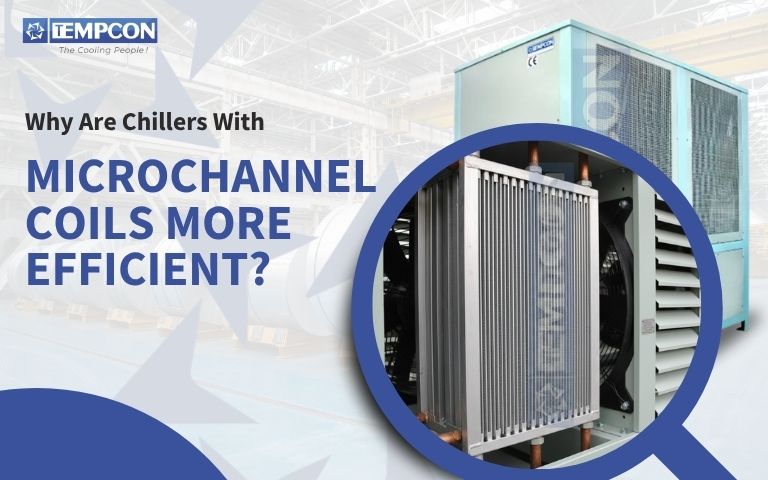
Efficiency has become a primary decision factor due to increased energy costs and sustainability governance. One technology that has significantly improved chiller performance in recent years is the use of microchannel coils, especially in air-cooled condenser applications.
Microchannel coil technology represents a shift from conventional fin-and-tube heat exchangers toward compact, high-performance designs. They deliver measurable gains in energy efficiency, operational reliability, and lifecycle cost savings.
Efficiency has become a primary decision factor due to increased energy costs and sustainability governance.
One technology that has significantly improved chiller performance in recent years is the use of microchannel coils, especially in air-cooled condenser applications.
Microchannel coil technology represents a shift from conventional fin-and-tube heat exchangers toward compact, high-performance designs.
Tempcon’s Advanced Industrial Cooling Reinforces India’s Iron and Steel Industry
How Microchannel Coils Increase Chiller Efficiency?
Microchannel coils improve industrial chiller efficiency by increasing heat transfer while reducing energy consumption. Their unique construction allows chillers to reject heat more effectively, operate at lower pressures, and consume less power for the same cooling capacity.
To understand why this technology delivers superior performance, it is important to examine the individual design and operational factors that contribute to these efficiency gains.’s industrial ACs are built with corrosion-resistant materials and designed for such metal industry operations.
Enhanced Heat Transfer Performance
Microchannel coils consist of flat aluminium tubes containing multiple small internal flow channels. This design provides a much larger heat transfer surface area within a smaller volume.
The increased surface contact between the refrigerant and the tube walls improves convective heat transfer. At the same time, thinner tube walls reduce thermal resistance, allowing heat to move more quickly from the refrigerant to the surrounding air. This results in faster and more uniform heat rejection in the condenser.
For industrial chillers, improved heat transfer means the system can achieve the required cooling output with lower temperature differences. It directly improves the overall efficiency.
Lower Condensing Pressure and Compressor Load
One of the most significant contributors to chiller power consumption is the compressor. Microchannel coils help reduce compressor workload by enabling more effective heat rejection at lower condensing temperatures.
When heat is removed efficiently from the refrigerant, the condenser operates at a lower pressure. Lower condensing pressure reduces the compression ratio. In turn, it decreases compressor energy consumption.
This reduction translates into substantial energy savings over time. From an engineering standpoint, improved condenser performance also enhances system stability and reduces stress on critical components
Reduced Refrigerant Charge
Where stainless steel components cannot be used due to design or cost constraints, the next best solution is epoxy-coated coils. Industrial-grade epoxy coatings act as a protective shield to safeguard metal parts from chemical attack and oxidation.
The advantages of epoxy coating include:
- Creates a chemical barrier against corrosive fumes
- Prevents oxidation and long-term metal degradation
- Extends the functional life of the coil significantly
It’s crucial to note that standard AC coatings found in residential units are not enough in such environments. Only heavy-duty industrial epoxy coatings protect coils effectively in aluminium plant environments.
Lower Air-Side Pressure Drop and Fan Energy Savings
Air-side pressure drop across the condenser directly affects fan power consumption. Microchannel coils are thinner and more aerodynamically efficient than traditional deep coil assemblies. They reduce the resistance to airflow.
With reduced air-side pressure drop, condenser fans can operate at lower speeds or require less power to move the same volume of air. This reduces auxiliary energy consumption and contributes to lower overall chiller power usage.
Additionally, lower fan power requirements often lead to quieter operation and reduced mechanical wear on fan motors and bearings. It creates an ideal setup for many industrial environments.
Compact and Lightweight Design Advantages
SpecialiThe compactness factor of microchannel coils allows chiller manufacturers to optimise unit layout and airflow paths, further enhancing thermal efficiency.
For plant engineers, compact chillers offer easier installation, reduced structural load requirements, and better suitability for rooftop or space-constrained installations. Smaller coil dimensions also allow for improved air distribution across the condenser surface. This feature ensures consistent performance even at partial loads.
Improved Corrosion Resistance and Long-Term Performance
IndustriaAll-aluminium microchannel coils eliminate the galvanic corrosion issues commonly associated with copper-aluminium combinations. This makes them particularly suitable for harsh industrial environments, coastal locations, and areas with high humidity or airborne contaminants.
Improved corrosion resistance helps maintain clean heat transfer surfaces over time. When coil surfaces remain intact and free from corrosion buildup, thermal performance remains closer to original design values throughout the equipment’s operating life.
Reduced Operating and Lifecycle Costs
The efficiency benefits of microchannel coils extend beyond initial energy savings. Lower compressor and fan power consumption reduces electricity costs considerably. It is important for process chillers operating 24/7.
Reduced refrigerant charge lowers material costs and simplifies maintenance. Improved durability and corrosion resistance decrease the frequency of repairs and component replacements. Together, these factors contribute to a lower total cost of ownership over the chiller’s lifecycle.
Design Considerations and Maintenance Requirements
While microchannel coils offer clear efficiency advantages, proper system design and maintenance are essential to maximise their benefits. The small internal channels require clean refrigerant and effective filtration to prevent blockage.
Externally, fins must be cleaned using appropriate methods to avoid physical damage. With correct maintenance practices and proper application design, microchannel coils perform reliably in demanding industrial cooling applications.
Choosing Efficient Chillers for Long-Term Industrial Performance
Chillers equipped with microchannel coils represent a significant advancement in industrial cooling efficiency. By improving heat transfer, reducing compressor and fan energy consumption, lowering refrigerant charge, and enhancing durability, microchannel technology delivers measurable performance and cost benefits.
Contact Tempcon today to discuss your cooling challenges and explore efficient, reliable chiller systems engineered for long-term industrial performance.