
Heat Is The Unavoidable Consequence of Electrical Flow
Look at this formula –
Q˙resistive =I²R
This is the reality of heat generation in BESS operations. You can’t move current from your battery to the grid without producing heat.
The main problem is the square – I²R. This basically means that due to resistance, when a grid operator calls on your BESS to dump massive amounts of power to stabilize a frequency drop, the current spikes. Because that current is squared, the heat doesn’t just increase – it multiplies quadratically.
Heat = Bad When It Comes To Batteries and BESS Cooling
Lithium ion batteries store and supply energy by moving lithium ions between anode and cathode and vice versa.
Now, as the electric flows, the ensuing heat does three types of damages:
When a battery has to work in raised temperatures, a chemical reaction happens which results in the thickening of the protective Solid Electrolyte Interphase layer.
Active lithium ions get trapped in this extra-thick layer. Lesser lithium ion = lesser energy storage capacity for the battery.
Here’s crude example. A container that could hold 2MWh of energy on Day 1 might only be able to hold 1.6MWh by Year 3 if poorly cooled.
In most grid-scale BESS projects, a cell is considered to have reached End of Life when its energy holding capacity decreases by more or less 20%.(But of course it varies). If a system is underwritten to hit EOL in 10 years at 25 degree celsius, running it at higher temperature means you hit that exact same EOL threshold before the expected time.
Thirdly, just like the human heart fails to pump blood when the veins become thick, a battery whose Solid Electrolyte Layer has become thick fails to push energy as fast as the grid demands. Because the “pipeline” itself has become less spacious. As a result, resistance increases. Electrical resistance = more heat generated.
Air Cooling Vs Liquid Cooling For BESS
Earlier first generation BESS facilities used industrial air conditioning to cool the cells. Just a simple loop of – cold air in, hot air out. It doesn’t work when the grid calls for a 2C discharge in 40°C ambient
It doesn’t work when the grid calls for a 2C discharge in 40°C ambient. Air carries very little heat per unit volume and makes poor contact with cell surfaces. And then there is the problem of uneven cooling – cells in the middle of the rack don’t get cooler than those in the edge.
Introducing Tempcon Thermoregulation Chillers For BESS
As opposed to industrial air conditioners, Tempcon Chillers pump chiller fluid through cold plates. These plates remain in direct contact with the cells. The result? Even cooling and precise temperature control.
Tempcon Air-Cooled Scroll Chiller For BESS Cooling (TECAC52SCS, 11 TR)
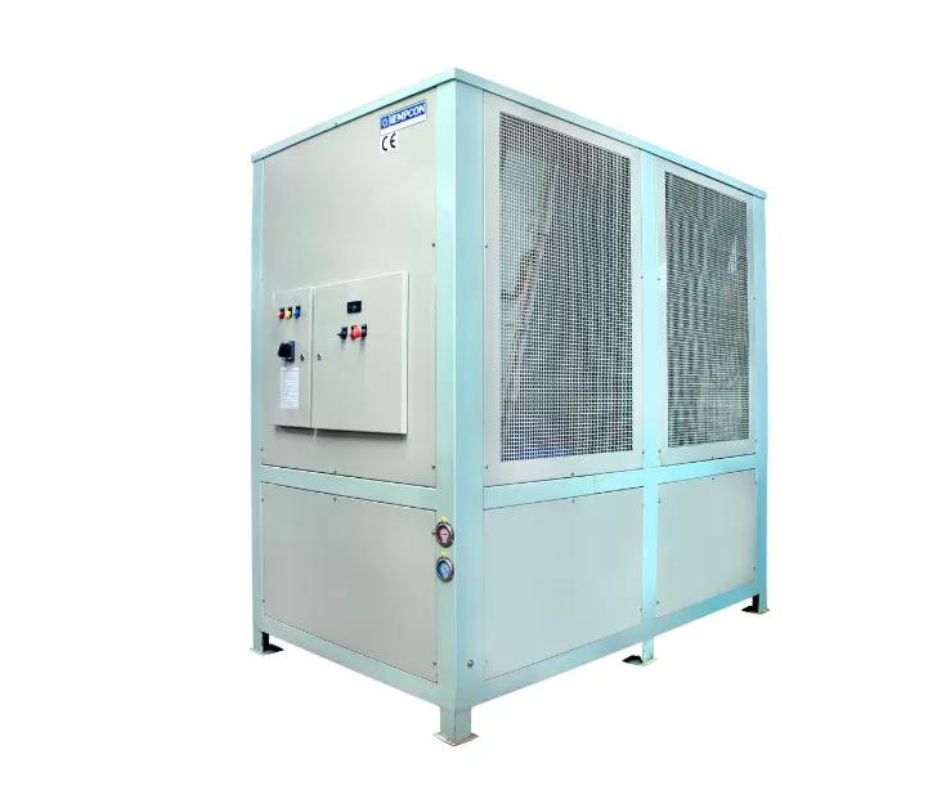
For BESS projects located in remote locations – be it solar parks or substations – anywhere where there is a water scarcity. This air cooled model doesn’t need water – it rejects heat into the ambient.
The Tempcon air cooled chiller is rated at 45 degree celsius ambient. This means this is a perfect thermoregulation chiller for facilities in tropical climates. The Copeland/Danfoss scroll compressor and shell-and-tube evaporator keep efficiency up at full load, and the hot-gas bypass on the expansion valve lets the unit turn down cleanly when the battery is idle, instead of cycling on and off.
Tempcon Water Cooled Thermoregulation Chiller For BESS Cooling
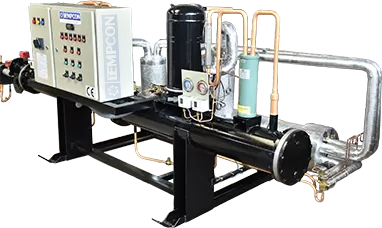
BESS facilities situated in places where water availability is not an issue can get more value for money if they use water cooled chillers. A water-cooled condenser runs at a lower condensing temperature than an air-cooled one on a 45°C day, so the compressor draws less power for the same cooling output. For a large BESS plant cycling daily, that’s a huge power saving.
Tempcon Glycol and Brine Chiller For BESS Cooling

This is the modern hero of BESS cooling. In Indian temperatures, water turning to zer degree is not a valid fear. Yet BESS facilities use glycol+water mixture because glycol based coolant prevents internal oxidation and organic growth.